
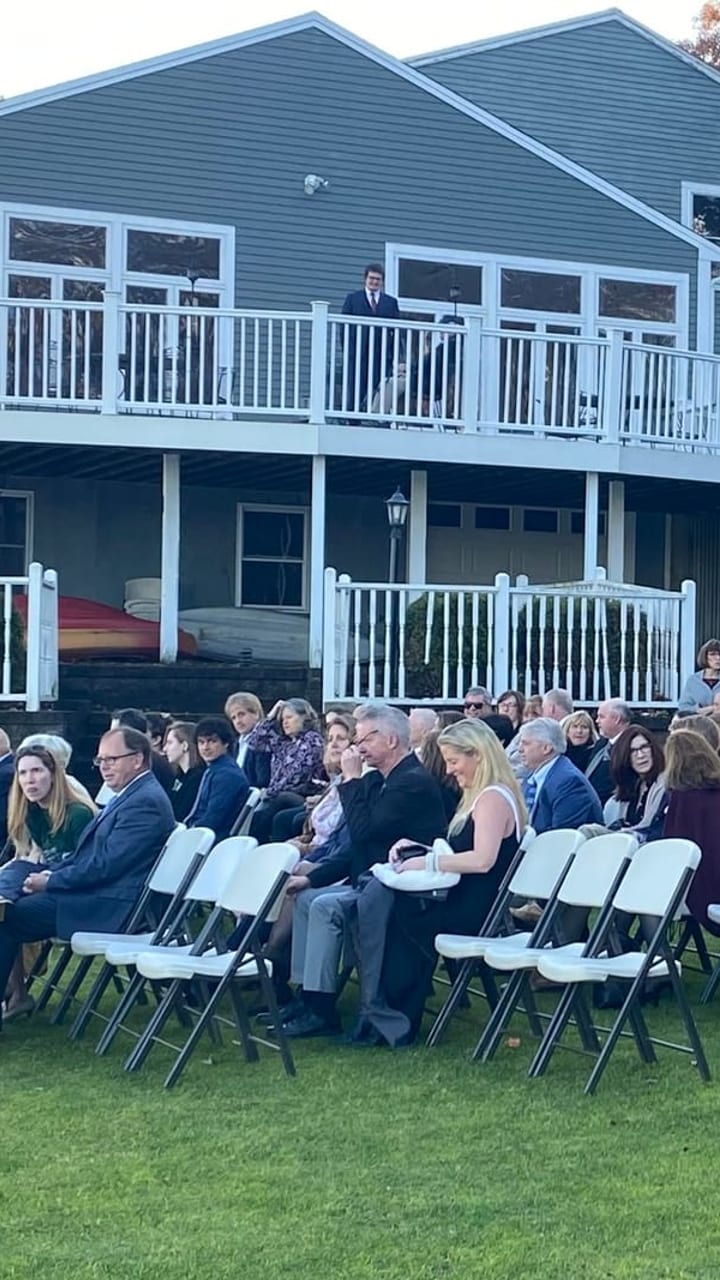
What changes on the day when there is no wedding party? Less than you'd think, and all of it is logistics. The processional gets shorter, the grand entrance becomes just the two of you, the toasts lose their customary speakers (and gain whoever you actually want to hear from), the family photos go faster, and a handful of small jobs that attendants usually do need a name next to them. That is the entire list. Nothing about the night is worse, some of it is better, and after twenty years of weddings I can tell you the guests notice a wedding party's absence for about four seconds, right around the entrance, and then never again. Let's go through the day in order.
The morning
The getting-ready morning is calmer, because the people who usually need wrangling are not there to wrangle. You can still have friends with you; they just are not on the clock. The two things a wedding party quietly carries in the morning are the rings and the vows. Give each to a person or a pocket, and tell the officiant who has them.
The ceremony
The processional is the parents, then the two of you: together, or each with whoever walks you, or alone. Tell whoever plays the music that it is short; a processional chosen for eight couples is two minutes of empty aisle when there are none. During the ceremony someone holds the flowers while the rings are exchanged: the officiant, a parent in the front row, or a small table beside you. Decide it at the rehearsal, not at the altar. Ask the clerk who issued your license what it needs at the ceremony; that is their answer to give, not mine.
The photos
This is the part that gets better. Family formals usually run about fifteen groupings at three minutes each, which is the forty-five minutes that swallows your cocktail hour. Without wedding-party groupings you can be done in twenty and back in the room with your guests for most of the hour, which is what everyone wants anyway.
The entrance
A grand entrance for two takes five minutes instead of ten, and it is a better entrance, because the room's whole attention is on the only two people who walk in. Give your MC the names you want announced and how to say them. If you want a bigger moment, have your parents announced first, then you, then straight into the first dance the way we do it around here.
The toasts
Without the customary speakers, the toasts are whoever you choose: a parent, a sibling, a friend, one from each side, or none. Some couples give a short welcome themselves and skip the toasts entirely; that is a five-minute welcome instead of a ten-minute block, and nobody at a wedding has ever complained that the speeches were short. Whoever speaks, the same rule applies: ask them early, tell them how long, and get them a mic.
The floor
Here is the one real gap. When open dancing starts, the wedding party is usually the first ten people on the floor, and a floor with ten people on it fills; a floor with two people on it does not. Without a wedding party, the two of you start the dancing yourselves and ask four or five friends ahead of time to be right behind you. Tell your entertainment this is the plan. A good MC will build the first set for it, and by the second song nobody remembers who was first.
The jobs
Everything else attendants do is a job that needs a name: who carries the cards and gifts to the car, who holds the envelopes, who bustles or pins, who runs and gets the two of you when the MC needs you, who lines guests up for the send-off, and who makes the rain call. Put a name next to each on the team sheet, and none of it is a gap.
Tap the "no wedding party" preset in the builder and it drops the entrance to five minutes and reshapes the toasts; change whatever else is different about your day.
Then use the toast planner to set who speaks, in what order, and for how long, with a card for each of them.
Quick answers
- Do we still need a rehearsal? A short one. Walk the aisle, decide who holds what, and tell the officiant. Twenty minutes.
- Will it look empty in the photos? No. It looks like the two of you.
- Who stands with us during the ceremony? Nobody has to. If you want someone there, a parent or a child beside each of you does the job without a title.
A wedding party is a tradition, and traditional does not mean required. Decide the jobs, tell the team, and enjoy having fewer people to manage.
Thanks! Chuck