
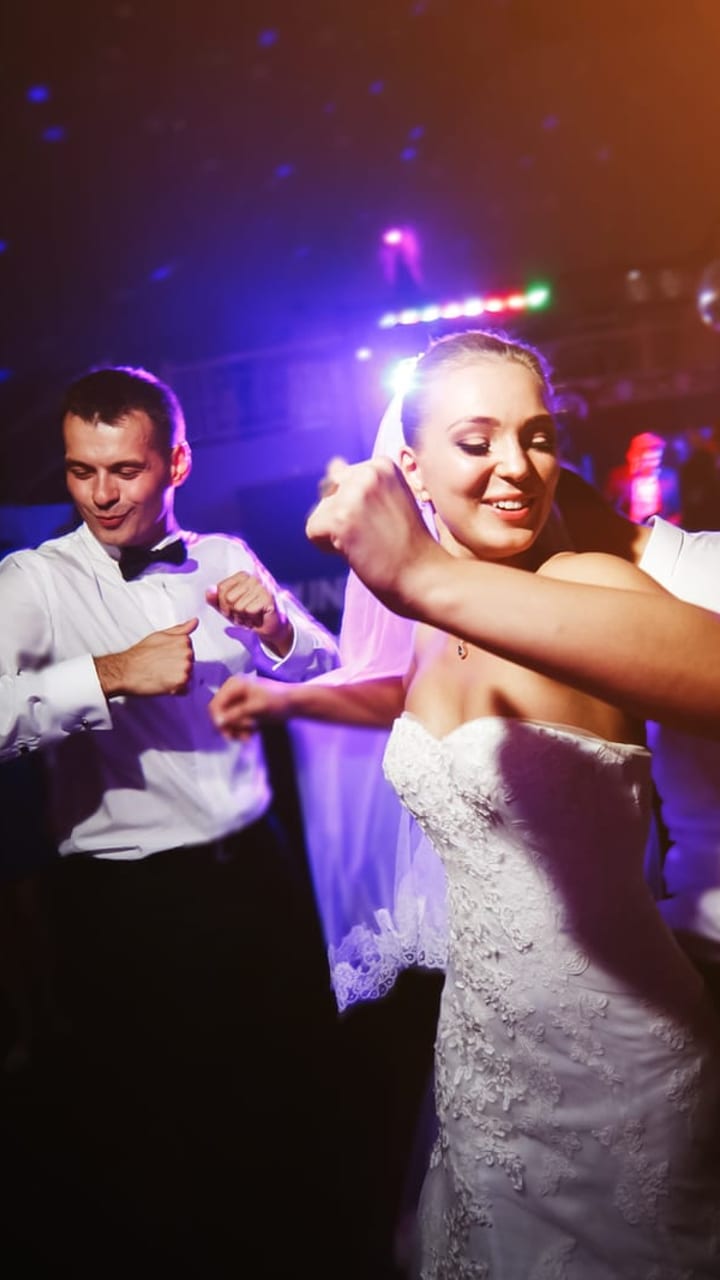
Have you ever been to a wedding reception that feels rushed? Have you ever been to one that feels like it is never going to end? I've been to both (I've seen everything happen at a wedding, and more), and neither one is much fun. So how fast should your reception move? My answer, after twenty years of watching rooms from the middle of them: start relaxed and build, so the night ends with a packed floor instead of a tired one. That is the mixed pace, and it is the one I recommend for almost every wedding. The catch is that your preference can get overruled by the venue's hours, the caterer, your guest count, or (like we talked about in the photographer article) how long your photos take. Here are the three paces, the bumps in the road, and what you need to know before you pick one.
The relaxed affair
Think about a wedding reception in your head right now. What do you see? Most likely an elegant room, a cocktail hour with plenty to drink and food going around, a big meal, then dancing, and a day that flows without anyone looking at a watch (especially if you are reading this in preparation for your own wedding). That is the relaxed affair, and it needs one thing more than anything else: time. If your reception is short (four hours or less), a relaxed pace means cutting some of the traditional events to make room. A longer block gives you room to breathe.
The pace of your timeline is a delicate balancing act. A rushed timeline stresses the providers, and your guests will notice. That stress radiates through a room (think of the way a child reacts to parents who are stressed out), and it kills the mood. The elated mood of a wedding reception is easy to kill and hard to revive. On the flip side, a timeline that is too slow drags, and your guests get bored and restless. If whoever is on the mic can't read the room, nobody fixes it. The key is preparation, and an honest guess about what kind of crowd you'll have.
The fast-paced reception
What comes to mind when you think of a fast-paced reception? A lively crowd that dances early and ends early. A quick buffet or heavy appetizers instead of a plated dinner, and a celebration that starts fun and stays fun. A fast-paced reception should not run longer than five hours at most, and it has drawbacks. If the schedule feels too packed, you wear your guests out. If your entertainment is the laid-back type, a fast pace throws them off. I advise against the fast pace in general, but with a lot of preparation it can be done.
The mixed reception
The mixed reception borrows from both. Imagine a laid-back cocktail hour, a dinner where people actually talk, and then the energy rising step by step until the night ends with everyone on the floor feeling like they are part of the celebration. It works on a short time frame too, but you will probably have to omit some traditional events to get a lot of open dancing at the end.
Like any timeline, it's a balancing act. A mixed reception that starts relaxed and does not build fast enough leaves your guests docile, and that's a tough hole to climb out of. One that builds too fast leaves them burned out before the last hour. Whoever runs your music has to build the energy on purpose, a notch at a time.
What decides the pace for you
The pace of your reception is up to you, but only after you collect the facts. Plan for venue time constraints, guest count, how long the caterer needs to feed everyone, transportation, the distance between the ceremony and the reception, you name it. A few honest numbers: a plated two-course dinner for a hundred and twenty people takes about an hour, a buffet about forty-five minutes, a wedding party entrance ten, two parent dances ten. A five-hour reception usually leaves ninety minutes or more of open dancing, and when the floor gets less than that, the night feels short no matter what the pace was on paper. Six hours is the long end of what I have seen work. The longest I have done is eight.
What usually goes wrong here is the venue's block. Many venues sell the reception as a fixed number of hours, and if that block is short, a relaxed reception is a challenge. Find that number out before you fall in love with a pace.
Pick a pace in the builder below and it spaces the night to match: relaxed adds a cushion after every formality, mixed adds one after the toasts and after dinner, and fast adds none.
Quick answers
- Which pace should we pick? Mixed. A relaxed start and a big finish is the shape that works in the most rooms.
- How long should the reception be? Five hours from cocktails to the last song is the sweet spot; six is the long end.
In the next article we put the pieces in order, with the math. Whatever pace you choose, decide it early and tell everyone who is running your day, because the pace is not a mood. It's a plan.
Thanks! Chuck